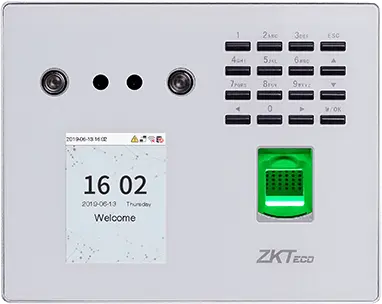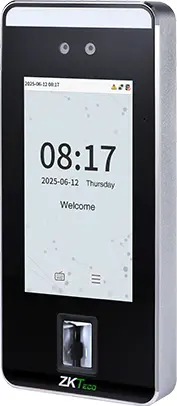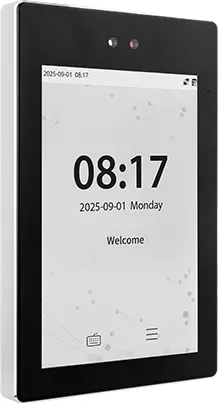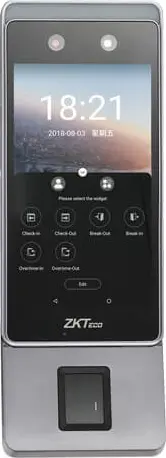
- 6,000 faces (10,000 optional)
- Wi-Fi 2.4 and 5 GHz, 4G, Bluetooth
- Face recognized up to 3 m
- Card and fingerprint versions
The Horus E1 is the size of a large phone and runs Android. Its 4G and dual-band Wi-Fi make it useful where there is no network cable: worksite base camp, temporary branch, pop-up store. It recognizes faces up to 3 m away.
To clock in on a worksite without a terminal, the TEMPO time and attendance app lets employees clock in from their phone with GPS location and photo. See also construction site attendance.
Caractéristiques techniques
- Screen
- 5-inch IPS touchscreen, 720 × 1280
- Camera
- Dual 2 MP camera
- Face capacity
- 6,000 (10,000 optional)
- Fingerprint capacity
- 6,000 (10,000 optional), E1-FP version
- Card capacity
- 10,000, E1-RFID and E1-FP versions
- Verification modes
- Face (E1); face and card (E1-RFID); face, fingerprint and card (E1-FP)
- Recognition distance
- Up to 3 m
- Card type
- ID or Mifare (E1-RFID, E1-FP)
- Communication
- 4G; TCP/IP 10/100 Mbit/s on E1-RFID and E1-FP; Bluetooth 4.0
- Wi-Fi
- 2.4 and 5 GHz
- Access control
- Optional with the DM10 module (E1-RFID, E1-FP)
- Power supply
- 12 V, 2 A
- Operating temperature
- 0 to 50 °C
- Humidity
- 20 to 80%
- Dimensions
- 158 × 74 × 15.6 mm (E1); 205.33 × 74 × 17.7 mm (E1-RFID, E1-FP)
Données du fabricant. Selon la variante et le micrologiciel, certaines valeurs changent.
Questions fréquentes
Does the Horus E1 work on 4G without a local network?
The manufacturer states 4G, 2.4 and 5 GHz Wi-Fi and Bluetooth. The base E1 version has no wired network port; the E1-RFID and E1-FP versions do.
Which versions of the Horus E1 exist?
Three: E1 (face), E1-RFID (face and card) and E1-FP (face, fingerprint and card). The last two add a wired network port.